
Illinois Tax Incentives
What to do when the Affordable Care Act Impacts Case Settlements:
The Benefits of an Accessibility-Focused Case Evaluation
A White Paper by Michael Fiore
One of the likely unintended consequences of the Affordable Care Act is that Special Need Trusts may be impacted due to settlement criteria that can be based on past, present, and future medical needs.
Teleseminars on Disability, Diversity, and the Changing Workforce. One hour of learning that can change the way that you think.
Tech Update: Read an article about the implications of 32-bit and 64-bit processors for Assistive Technology Solutions.
Looking for qualified candidates with disabilities?

A Job Board for job seekers with disabilities and the businesses looking to hire them.
Illinois Tax Incentives
- Assistive Technology Program
- Capital Access Program
- Chamber of Commerce
- Department of Commerce and Economic Opportunity
- Disabilityworks
- Enterprise Zone Program
- Health Benefits for Workers’ with Disabilities
- High Impact Business
- Historic Preservation Tax Credit Program
- Regional Employer-Assisted Collaboration for Housing
- Small Business Jobs Creation Tax Credit
- Vocational Rehabilitation
Assistive Technology Program
The Illinois Assistive Technology Program website has links and information on obtaining and using assistive technology in the state of Illinois.
Finding a way to pay for assistive technology is often a major obstacle for people with disabilities. Illinois Assistive Technology Program has devoted a special section of its website to assistive technology funding. Some of the categories it covers are computers, education and employment.
Capital Access Program
assists businesses with capital financing needs. It is designed to encourage financial institutions CAP to make loans to small and new businesses that do not qualify under conventional lending policies, using small amounts of public resources to generate private bank financing that might not otherwise be available.
Funding from a Capital Access Program loan could be used to start or grow a business leading to more employment opportunities for workers with disabilities.
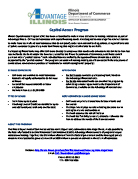
Capital Access Program Fact Sheet PDF
Chamber of Commerce
The Illinois Chamber of Commerce website has pertinent information, links and other resources for businesses to allow them to thrive in a global economy.
Department of Commerce and Economic Opportunity
The Illinois Department of Commerce is the State Agency that leads economic development efforts for Illinois. Its main focus is to retain and create jobs in Illinois.
Disabilityworks
Disabilityworks, an initiative from the Chicagoland Chamber of Commerce, the Illinois Department of Commerce and Economic Opportunity and the City of Chicago, is designed to increase employment opportunities for people with disabilities throughout Illinois.
Enterprise Zone Program
The Illinois Enterprise Zone Program is designed to stimulate economic growth and neighborhood revitalization in economically depressed areas of the state. This is accomplished through state and local tax incentives, regulatory relief, and improved governmental services.
Very often, people with disabilities live in areas that are economically depressed and in need of revitalization. Hiring disabled individuals from these zones would reverse the unemployment trend among this population and give their neighborhoods a much needed lift.
Contact information regarding the Enterprise Zone program.
This website has additional information on Illinois’ Enterprise Zone Program.
Health Benefits for Workers with Disabilities
The goal of Health Benefits for Workers with Disabilities (HBWD) is to help people with disabilities work with full Medicaid healthcare benefits. HBWD not only encourages enrollees to work, but to increase the number of hours they are currently working.
If you are an individual with a disability, between the ages of 16 and 64 and working, you may qualify for HBWD. Workers with countable income of up to $3,404 per month for a single person and $4,588 per month for a couple may qualify for the program. Unlike other Medicaid programs, HBWD allows enrollees to have up to $25,000 in assets. Depending on their income, enrollees pay a monthly premium based on their income range to receive comprehensive healthcare coverage.
High Impact Business
The High Impact Business program supports large-scale economic development activities by providing tax incentives (similar to Enterprise Zones) to companies that make substantial capital investments in operations and create or retain an above average number of jobs. Businesses may qualify for: investment tax credits, a state sales tax exemption on building materials and/or utilities, a state sales tax exemption on purchases of personal property used or consumed in the manufacturing process or in the operation of a pollution control facility.
Eligible projects must invest a minimum of $12 million and create 500 full-time jobs, or $30 million investment with the retention of 1,500 full-time jobs. Investments must take place at designated locations in Illinois outside of an Enterprise Zone.
Some of the jobs created/retained through the High Impact Business program can be occujpied by people with disabilities.
Historic Preservation Tax Credit Program
The Illinois Historic Preservation Tax Credit Program provides a state income-tax credit equal to 25% of a project’s qualified expenditures to owners of certified historic structures located within River Edge Redevelopment Zones (Aurora, East St. Louis, Elgin, Peoria & Rockford) who undertake certified rehabilitations during the taxable year. The substantial rehabilitation investments will create jobs in Illinois, stimulate the economies of River Edge communities, and revitalize historic structures and neighborhoods. The Illinois Historic Preservation Tax Credit Program runs from January 1, 2012 to December 31, 2016.
This tax provision could generate employment opportunities for workers with disabilities who live in River Edge Redevelopment Zones.
Regional Employer-Assisted Collaboration for Housing
Employer-assisted housing is a cost effective, easy to administer way for employers to help their employees buy or rent homes close to work. In Illinois, the Metropolitan Planning Council, Housing Action Illinois, and more than a dozen Regional Employer-Assisted Collaboration for Housing partners make it easy and financially compelling for employers to offer Employer-assisted housing programs to their employees. These local housing experts administer the program, provide homeownership education and financial counseling, and manage the down payment or rental assistance provided by employers. Special state incentives, including tax credits and matching funds, make Regional Employer-Assisted Collaboration for Housing Illinois even more compelling. Through Regional Employer-Assisted Collaboration for Housing Illinois, more than 1,800 employees have bought homes since 2000.
This web site states there are many benefits for employers who assist workers with purchasing or renting homes. Some are: improved employee retention and productivity, reducing recruitment/training costs, commuter stress reduction, less absenteeism and tax benefits.
Finding affordable, accessible housing is a major problem in the disability community, even for those who are employed. Because of the lack of appropriate housing, an employer assisting a disabled worker with purchasing or renting a home would be very advantageous for a disabled worker as well their employer.
Small Business Jobs Creation Tax Credit
The Illinois Small Business Jobs Creation Tax Credit program provides small business owners and non-profits with an extra boost to grow their business over the next few years. After creating one or more new, full-time positions that meet the eligibility requirements, small businesses can register online to receive a $2,500 per job tax credit. The program runs from July 1, 2012 to June 30, 2016.
Some of the jobs created as a result of this tax credit could be held by workers with disabilities.
Vocational Rehabilitation
The goal of Illinois' Vocational Rehabilitation is to help people with disabilities find gainful employment that has a living wage and career advancement. Often, Vocational Rehabilitation programs will offer employers (or potential employers) the services and supports needed to hire, train and retain disabled individuals.
