
Featured Articles
What to do when the Affordable Care Act (ACA) Impacts Case Settlements:
The Benefits of an Accessibility-Focused Case Evaluation
A White Paper by Michael Fiore
One of the likely unintended consequences of the Affordable Care Act is that Special Need Trusts may be impacted due to settlement criteria that can be based on past, present, and future medical needs.
Teleseminars on Disability, Diversity, and the Changing Workforce. One hour of learning that can change the way that you think.
Tech Update: Read an article about the implications of 32-bit and 64-bit processors for Assistive Technology Solutions.
Looking for qualified candidates with disabilities?

A Job Board for job seekers with disabilities and the businesses looking to hire them.
What to do when the Affordable Care Act Impacts Case Settlements:
The Benefits of an Accessibility-Focused Case Evaluation
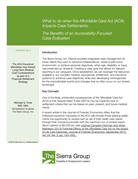
One of the likely unintended consequences of the Affordable Care Act is that Special Need Trusts may be impacted due to settlement criteria that can be based on past, present, and future medical needs.
Download or View The Benefits of an Accessibility-Focused Case Evaluation  PDF
- 136 K
PDF
- 136 K
Occupational Alert: Nursing Trends
 New Article: Healthcare consolidation trends continue to impact the nursing profession and offer more employment opportunities with greater strings and conditions. Jackie Pickering, CRC offers her insight on the impact of those trends to those managing disability claims in her current installment of Occupational Alert: Nursing Trends. PDF - 185 K (opens in a new browser window)
Universal Access and Web Design: What You Should Know about Flash
 If
a picture is worth a thousand words – a Macromedia Flash presentation
is probably worth volumes. Flash technology, in a general sense, may be one
of the most widely available technologies used on the web. For developers,
the ability to program one multimedia presentation that can be viewed the same
on nearly all computers makes the technology very appealing. However, for individuals
with disabilities, Flash can introduce unique accessibility problems. More information on multimedia accessibility.
If
a picture is worth a thousand words – a Macromedia Flash presentation
is probably worth volumes. Flash technology, in a general sense, may be one
of the most widely available technologies used on the web. For developers,
the ability to program one multimedia presentation that can be viewed the same
on nearly all computers makes the technology very appealing. However, for individuals
with disabilities, Flash can introduce unique accessibility problems. More information on multimedia accessibility.
Information and Statistics about Hearing Loss
 Hearing
loss is a common problem in modern society due to the combined effects of noise,
aging, disease, and heredity. Hearing is a complex sense involving both the
sensitivity of the ear as well as the ability to understand speech. For information
and statistics about hearing loss, click here for a summary
prepared by National Institute of Deafness and Communication Disorders.
MS Word - 34 K
Hearing
loss is a common problem in modern society due to the combined effects of noise,
aging, disease, and heredity. Hearing is a complex sense involving both the
sensitivity of the ear as well as the ability to understand speech. For information
and statistics about hearing loss, click here for a summary
prepared by National Institute of Deafness and Communication Disorders.
MS Word - 34 K
Guidelines for Creating Accessible Media
 The
National Center for Accessible Media (NCAM)
serves as the research and development arm for WGBH’s Media Access Group.
One of the main concentrations of NCAM is
the continued enhancement of accessibility to media for people with disabilities.
In order to boost their mission, they have recently published a series of guidelines
that provide systematic solutions for making a variety of electronic media
accessible to users with sensory disabilities. This publication offers a collection
of various guidelines ranging from the creation of image access points for
people with visual impairments, to providing access to scientific and mathematical
expressions for all users with disabilities. View all guidelines, please visit NCAM’s website.
The
National Center for Accessible Media (NCAM)
serves as the research and development arm for WGBH’s Media Access Group.
One of the main concentrations of NCAM is
the continued enhancement of accessibility to media for people with disabilities.
In order to boost their mission, they have recently published a series of guidelines
that provide systematic solutions for making a variety of electronic media
accessible to users with sensory disabilities. This publication offers a collection
of various guidelines ranging from the creation of image access points for
people with visual impairments, to providing access to scientific and mathematical
expressions for all users with disabilities. View all guidelines, please visit NCAM’s website.
Janet Fiore, CEO of The Sierra Group is a ‘Monster’ Disability Expert.
 In
the decade and a half since the Americans with Disabilities Act was passed,
life has improved for many of this country’s 54 million disabled citizens.
But the landmark legislation can be seen as “both a tool and a sword.” That’s
the view of Janet Fiore, CEO of Sierra Group www.thesierragroup.com,
a consulting firm specializing in workers with disabilities.
In
the decade and a half since the Americans with Disabilities Act was passed,
life has improved for many of this country’s 54 million disabled citizens.
But the landmark legislation can be seen as “both a tool and a sword.” That’s
the view of Janet Fiore, CEO of Sierra Group www.thesierragroup.com,
a consulting firm specializing in workers with disabilities.
View the entire article by Dan Woog on "Disability Update 2007".
How to Create Accessible Portable Document Files (PDF)
 Learn
how to create accessible portable document files (PDF)
by creating PDF Tags. PDF Tags are a text-only representation of the PDF file
which is hidden inside the PDF file which is presented to screen readers instead
of the original file. Instructions on how to make your PDF's accessible.
Learn
how to create accessible portable document files (PDF)
by creating PDF Tags. PDF Tags are a text-only representation of the PDF file
which is hidden inside the PDF file which is presented to screen readers instead
of the original file. Instructions on how to make your PDF's accessible.
One Minute Challenge - Test your ADA knowledge:
 Three
True or False Questions about the ADA and
Hearing Impairments.
Three
True or False Questions about the ADA and
Hearing Impairments.
Title I of the ADA covers employment by private employers with 15 or more employees and state and local government employers of the same size. Section 501 of the Rehabilitation Act provides the same protections for federal employees and applicants for federal employment. Take the test – relax, we can’t see your answers.
